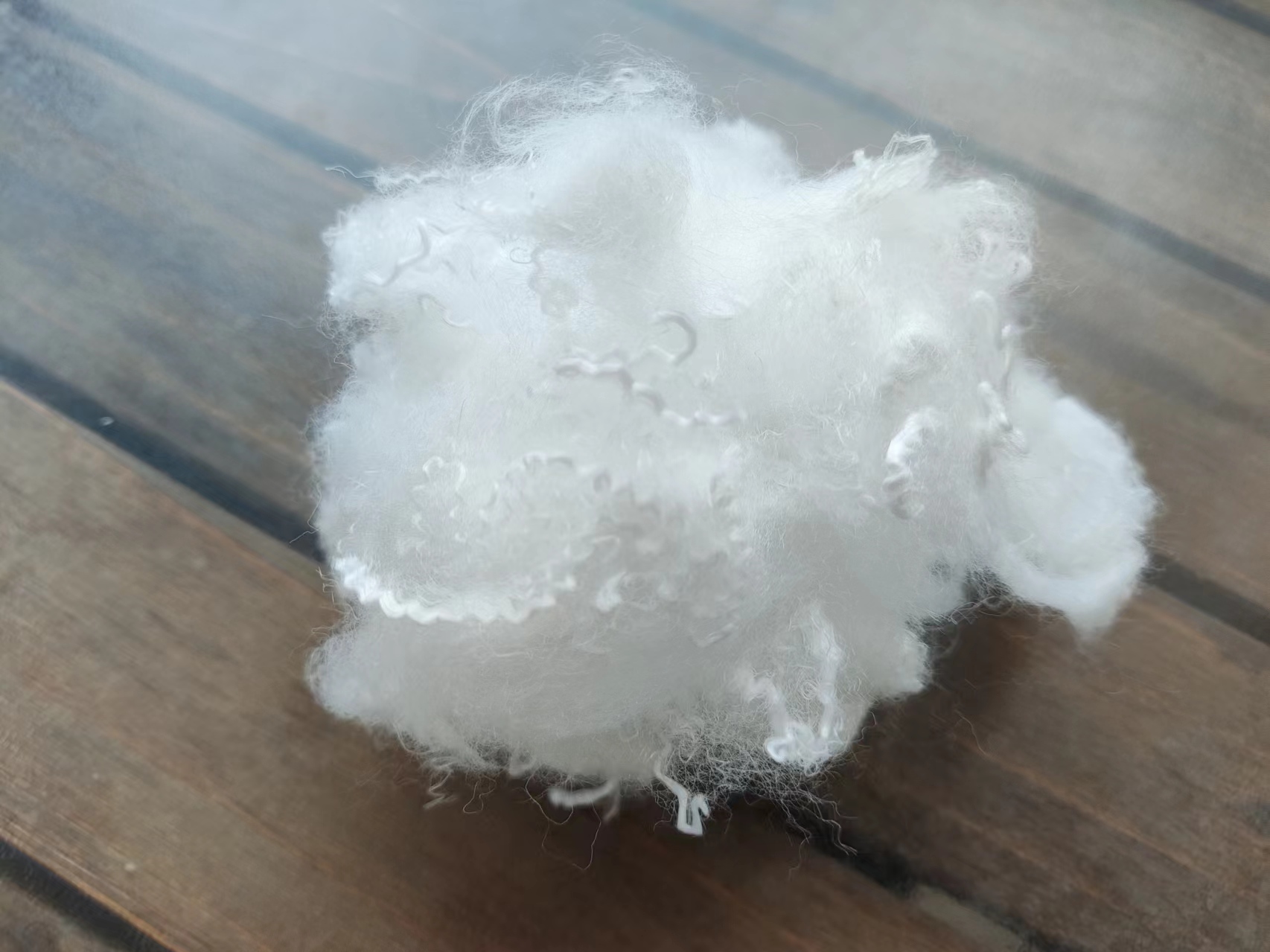
Main Application Categories of Polyester Staple Fiber
1.Filling (Direct Use)
Used directly in finished products where softness, bulk, and comfort are essential.

Applications:
Pillows
Quilts
Cushions
Toys
Thermal insulation (garments, bedding)


Suitable Fibre Specifications
Denier: Fine – Coarse (1.5D–15D)
Cut Length: Short – Long (32–64mm)
Fiber Type: Hollow / Solid
(Microfiber Down-like)
Crimp: Medium – High
2. Nonwoven Manufacturing
Designed for conversion into nonwoven fabrics through thermal bonding, needle punching, or other processes.

Applications:
Hygiene products
Wipes Filters
Geotextiles
Insulation materials
(industrial, automotive, construction)
Suitable Fibre Specifications
Denier: 1.2D – 6D; Cut Length: 32 – 64 mm
Bi-component PSF (Thermal Bonding Series)
Bi-component virgin HC PSF (core/sheath structure)
Bi-component Virgin LMF PSF
Structural PSF
Solid recycled PSF
Hollow non-siliconized PSF series
3.Spinning & Yarn Production
Suitable for processing into yarns and further textile applications.
Applications
Yarn production
Fabric manufacturing
Blending with cotton or viscose

Suitable Fibre Specifications
Denier: Fine (0.9D – 3D)
Cut Length:32mm – 51 mm
Fiber Type: Solid PSF
Fiber Selection Guide
Choosing the right polyester staple fiber depends on the specific performance requirements of your application. The following guide helps identify suitable fiber types based on key functional needs.
Selection by Performance Requirements
- For Softness & Comfort
Microfiber (fine denier)
Siliconized hollow conjugated fiber
Provides a soft touch, smooth feel, and enhanced comfort for filling applications.
- For Bulk & Thermal Insulation
Hollow conjugated fiber
Medium to high denier (3D – 15D)
Improves loft, resilience, and heat retention in bedding and insulation products.
For Nonwoven Strength & Structure
Solid polyester staple fiber
Non-siliconized fiber 1.5D – 3D range
Ensures stable web formation and strong structural integrity in nonwoven processes.
For Thermal Bonding Performance
Bi-component hollow conjugated PSF
Bi-component low melt fiber (LMF)
Enhances bonding efficiency and improves fabric cohesion during thermal processing.
For Spinning & Yarn Quality
Fine denier solid PSF (0.9D – 1.5D)
High uniformity and strength
Supports stable spinning performance, reduced breakage, and consistent yarn quality.
For Cost Efficiency
Solid recycled polyester staple fiber Medium denier range
Provides a balance between performance and cost for large-scale applications.
Selection by Key Parameters
Denier (Fineness)
Lower denier → softer, finer, better for spinning and premium filling
Higher denier → stronger, bulkier, better for insulation and cushioning
Cut Length
Short (32–38 mm) → suitable for spinning and fine nonwoven
Medium (38–51 mm) → general applications
Long (51–64 mm) → filling and high-loft products
Crimp
Higher crimp → improved bulk and elasticity
Moderate crimp → better processing stability and uniformity
Fiber Structure
Hollow fibers → lightweight, better insulation
Solid fibers → strength, durability, structural stability
End-Use Examples